


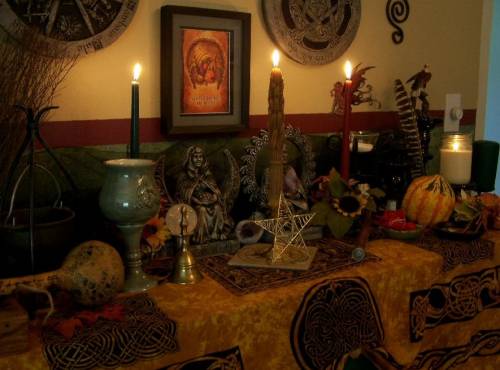
A Wiccan altar is the still point around which ritual gathers. It may be a carved table beneath a permanent shrine, a wooden box opened only by moonlight, a shelf above the reach of curious hands, or a square of cloth spread upon the floor. The surface matters less than the attention it receives.
Upon the altar, ordinary objects enter relationship. A cup becomes Water. A blade traces an unseen boundary. A stone holds Earth; smoke makes Air visible; flame awakens Fire. The altar is not a display of ownership. It is a place where purpose takes form.
Choosing a Wiccan Altar
Select a flat, stable surface large enough for the ritual you actually perform. A bedside table suits quiet devotion. A chest stores tools beneath its working top. A portable tray can be carried outside and cleared afterward. A box altar protects privacy in a shared home.
Face the altar north for grounding, east for beginnings and learning, south for transformative work, or west for intuition and ancestor rites. Some traditions place it at the center of the circle. Consistency helps the body remember where sacred work begins.
Accessibility is part of sacred design. The altar may be seated height, arranged for one-handed use, or divided across nearby surfaces. Leave open space for movement, mobility aids, and the safe handling of tools.

Altar Cloths and Seasonal Color
Green or white cloth creates a versatile foundation. Black deepens protection, divination, and Samhain work. Red strengthens vitality; blue welcomes healing and the western waters; gold honors the Sun. Change the cloth with the sabbat or spell, or keep one neutral fabric that belongs only to ritual.
Choose fabric that lies flat and will not catch sleeves, tools, or flame. A bare wood or stone surface is often safer for candle-heavy rites. The Color Meanings in Wicca guide connects altar colors with elements, weekdays, planets, and seasonal festivals.
Basic Wiccan Altar Ingredients
Candles
Candles hold attention and give intention a visible life. Use stable holders on heatproof trays. Keep every flame away from cloth, herbs, photographs, hair, and hanging sleeves. One white candle can replace a crowded row of colors.
Incense
Incense changes atmosphere and carries prayer through Air. A single stick, resin, herb, or smoke-free bowl of fragrant material can serve. The Censer and Incense guide explains charcoal, sand, blends, ventilation, consecration, and cleanup.
Crystals and Stones
Quartz, amethyst, citrine, rose quartz, smoky quartz, and ordinary pebbles may mark elements, hold a petition, or anchor the altar. Raw and polished stones serve different gestures; neither is inherently more magical. Choose pieces you recognize and can use safely.
Seasonal and Natural Materials
Flowers, nuts, shells, grain, fallen leaves, feathers found legally, bowls of rainwater, and local stones bring the living season onto the altar. Gather only where permitted. Do not strip plants, disturb nests, or remove objects from protected land. Return clean natural material to its own landscape or compost it.
Core Wiccan Altar Tools
Ritual tools help the witch cross into ceremonial awareness, direct attention, and express forces that cannot be held in the bare hand. They are companions, not requirements. Begin with what a rite needs. Learn one instrument fully before acquiring the next.
The Athame
The athame is a ritual blade, traditionally black-handled, used to cast the circle, direct force, invoke quarters, and trace symbols in air. It does not cut physical materials. Many traditions associate it with Fire; others place it beneath Air.
The Magic Wand
The magic wand directs energy through wood, crystal, or metal. It invokes, blesses, stirs, and traces. Often aligned with Fire or Air, it offers a gentler directing instrument when a blade does not suit the rite.
The Pentacle
The altar pentacle is a disk bearing a five-pointed star enclosed by a circle. It represents Earth, unity, and the elements held in balance. Place stones, charms, petitions, or vessels upon it for blessing. You can make one through the Altar Pentacle Craft.
The Chalice
The chalice belongs to Water, the Goddess, intuition, reception, and the womb of creation. It carries water, juice, cider, or wine and may be shared or offered within the circle.
The Cauldron
The cauldron is the dark vessel of transformation, death, inspiration, and rebirth. It may hold water, flowers, offerings, a safely contained candle, or scrying darkness. Keep vessels used for flame and incense separate from food preparation.
The Censer
The censer holds incense and gives Air a moving body. A hanging burner can travel around the circle; a stable heat-rated vessel belongs upon the altar. Sand beneath charcoal moderates heat and catches ash.
The Boline
The boline is the practical ritual knife, commonly white-handled. It cuts herbs, cord, fruit, candles, and wand wood. Where the athame shapes unseen force, the boline shapes physical matter.
The Broom
The broom or besom clears ritual space, guards thresholds, and witnesses handfasting. Its bristles may sweep just above the floor while gray, stagnant influence is visualized leaving the room.
The Ritual Bell
The ritual bell marks beginnings, invocations, transitions, and endings. Its fading note teaches that the silence after sound is part of ceremonial language.
Water, Salt, Music, and Clothing
Water and salt commonly represent Water and Earth and may bless the circle boundary. Use only a small amount of salt where it will not damage soil, stone, or household surfaces. Keep ritual water fresh and discard it after the rite.
Music, drum, tambourine, or repeated rhythm can gather attention and raise energy. Silence can do the same. Choose sound deliberately rather than filling every gap.
Ritual clothing signals a change of consciousness. A simple monochrome garment, shawl, robe, or piece of jewelry is enough. Keep long fabric away from fire. Clothing serves the rite only when the body can move safely inside it.
Representing the Goddess and God
Statues are optional. A holed stone, shell, smooth crystal, silver candle, or bowl may represent the Goddess. An acorn, antler symbol, rough stone, branch, gold candle, or upright crystal may represent the God. Two ordinary objects become sacred when relationship gives them meaning.
A rough crystal and polished stone can express complementary currents, but avoid reducing the divine to rigid gender rules. Let the altar reflect the theology you actually practice.
Half-Divider Altar Layout
The half-divider arrangement places Goddess symbols on the left and God symbols on the right, with working space at the center.

| Left — Goddess | Right — God |
|---|---|
| White or silver candle | Gold or yellow candle |
| Goddess symbol or statue | God symbol or statue |
| Chalice and water | Wand and censer |
| Cauldron | Bowl of salt |
| Pentacle and bell | Athame and boline |
| Crystals or offering plate | Lighting tools stored safely |
This layout is symbolic, not a command to crowd the surface. Place blades where they cannot roll, flames where they cannot reach cloth, and liquids where they cannot spill into incense or books.
Four-Quarters Altar Layout
The quarters arrangement organizes tools by direction and element, leaving divine symbols or the Book of Shadows at the center.

| North — Earth | East — Air | South — Fire | West — Water | Center |
|---|---|---|---|---|
| Pentacle, salt, stones, plants, cakes | Censer, incense, feather, bell, yellow symbol | Athame, red symbol, oil, safely held flame | Chalice, water, shell, cauldron, blue symbol | Divine symbols, working candle, Book of Shadows |
Correspondences vary. If your tradition places athame under Air and wand under Fire, arrange them accordingly and keep the chosen system coherent.
A Minimal Beginner Altar
Begin with five objects:
- A stone for Earth
- Incense or a feather for Air
- A candle or red object for Fire
- A cup of water for Water
- A central symbol for spirit, deity, or purpose
Add a Book of Shadows and one directing tool only when practice asks for them. Empty altar space is not failure. It gives the hands somewhere to work.
Portable, Hidden, and Outdoor Altars
A portable altar may fit inside a wooden box, cloth roll, or small bag. Use a battery candle, tiny elemental tokens, a folding cloth, and one cup. Photograph the completed arrangement or sketch it in your Book of Shadows so the same sacred geography can be restored wherever you travel.
Where privacy matters, let ordinary objects carry double meanings: a drinking glass for the chalice, a letter opener kept safely for the athame, a kitchen bowl for a flame-free cauldron, and a smooth stone for the pentacle. The altar can remain visible without explaining itself.
An outdoor altar should leave no wound. Use a fallen log, picnic cloth, or flat stone without moving habitat. Protect flame from wind or omit it. Take every ribbon, food item, candle, tool, and fragment home. The land is host, not storage.
Altar Safety and Practical Order
- Use heatproof trays beneath candles, charcoal, and cauldrons.
- Keep a lid, water, or appropriate extinguisher nearby when working with flame.
- Ventilate incense and offer smoke-free alternatives to participants.
- Sheath blades and keep them beyond the reach of children or unprepared guests.
- Use food-safe vessels for anything consumed.
- Label herbs, oils, and blends; keep unknown substances out of drinks.
- Separate liquids from books, electrical lights, ash, and hot metal.
- Never leave an active altar unattended.
Order does not weaken mystery. It gives mystery a chamber in which it can remain without causing needless harm.
Consecrate the Wiccan Altar
Clean the surface. Place one symbol of each element in its direction. Stand before the center and say:
Table of earth beneath candle and cup,
From ordinary silence now rise up.
Hold blade and blossom, water and flame;
Give every tool its purpose and name.
No pride shall crowd you, no danger remain;
Be center of blessing, devotion, and change.
Touch each quarter, then the center. Light one candle for thirteen attended minutes. Record the consecration date and layout.
Maintain a Living Altar
Remove dead flowers, stale water, ash, food, and completed petitions. Dust tools. Inspect cords, handles, holders, and blades. Change seasonal decorations before they decay. A living altar breathes because the witch tends it.
At the close of a rite, return every instrument to its place. The surface becomes quiet again, but not empty.
The altar waits.
Your practiced hands teach it how to wake.